
Search

Read author Peter Christian Hall's flu blog at Huffington Post:

PCH @ HuffPo

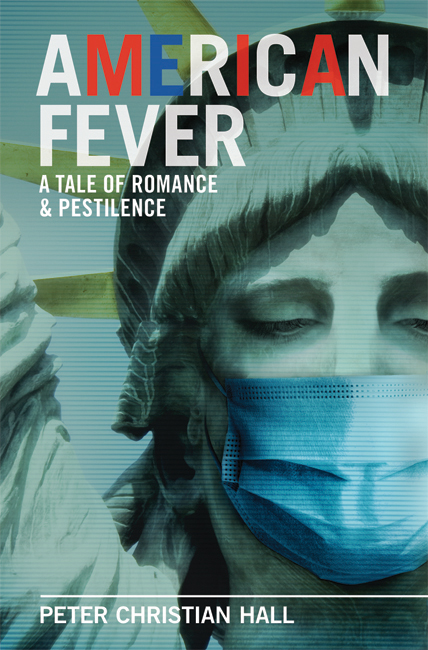
Link to American Fever

If you have a web site or social network profile (i.e., Facebook), please link to American Fever at

www.americanfeverbook.com

Every link will help us spread like a benevolent virus

Thank you!

Explore American Fever:
Powered by Squarespace
Sunday
03May2009

More Than ‘A Blog of the Pandemic Year’

Welcome to the words of a digital zombie.

I barely exist under any name, having relinquished my own years ago. I can’t say where I am now. I was long supposed dead.


I’m a flugitive, still pursued by the U.S. government for crimes I allegedly committed amid a collapse of order, justice, and sanity.


Yet I’m here, in your hands, breathing anew. Thank you.


A year ago I was depressed, hiding in a distant and unmentionable place under an assumed identity. I showed no emotion in that dingy Internet café when I discovered that my former self had risen in spirit. The flu blog I had written—shut down by the Feds during the Great Pandemic—was suddenly a big-selling book. Its vanished author was being mourned as a lost flu victim, a heroic and romantic American who died on the run from the Feds.


My humble texts had been preserved as if in amber by a program at the University of Auckland in New Zealand, where countless blogs from many nations were recorded during the emergency. By the time the H5N1 Pandemic followed swine flu, New Zealand was so well prepared that students and professors could play the roles of Irish monks in the Dark Ages, safeguarding a world of restless outbursts.


A few years after the transmogrified killer H5N1 receded and turned into a moderate seasonal ailment, an enterprising editor in New York sifted Auckland’s hoard and published excerpts from a number of American blogs whose authors had died during the Pandemic. Lost Voices was a critical and commercial success.


My older brother turned up to demand royalty payments from the publisher.


Inspired by the prospect of cash and impressed by kind reviews for my entry, my brother set about publishing my entire blog. Typically, he corrupted it.

The rascal spun nonsense about how he had lovingly tracked my escape from New York to a lonely unmarked grave in the Missouri woods. He doctored my blog posts, adding positive references to himself and removing the more factual mentions I’d made of him. As you’ll see, I had taken pains to avoid revealing that the biggest wretch in my blog—worse than any torturing Fed flunkie—was my kin. Wary that a few survivors might recognize his sleazy self, my brother scrubbed my blog.

Worse, he added a really sappy poem he claimed I had left behind. Talk about defiling the dead!

It was this contaminated version—which he sold for a sizable advance as A Blog of the Pandemic Year—that drew sufficient acclaim to catch my eye. Subsequent communications with lawyers and editors from my hole in the known world can’t be detailed here, but I’m grateful to all of them—and to some very courageous intermediaries—for their patience, fortitude, and discretion.

We have fully restored my blog.

I Blogged My Life to Pieces Selling Masks

The writing began humbly as an adjunct to a web site I had created to peddle masks (mostly respirators, actually), gloves, and goggles to Internet consumers. I never intended to write or make history. In fact, I had hoped to live quietly, watching the Pandemic unfold from a safe distance.

I had planned not to be anywhere near New York City when the first killer flu wave broke upon us. But as so many individuals and governments proved with devastating incompetence, it was really hard to prepare for a flu pandemic, even if you were positive one was coming. I was still in the city the day the first New Yorker succumbed, posted an initial entry as Day 1: Sign Up to Fight Killer Pandemic Flu!

I continued in that vein for more than half a year—through the second, shattering wave—until the government crashed my site.

I mainly intended to help people by offering advice and insights (and sure, blow off a little steam) as I sat, safe at home. Inevitably, some personal material crept into my account.

Soon I was shocked to find myself entertaining strangers around the world. Like a kid who sees adults laughing at his manic antics, I went too far now and then. Some entries are embarrassing, even for a guy who barely exists. A few are funnier than I meant them to be. Frequently the joke was on me.

Some things I wrote have since proven to be scientifically incorrect. That’s inevitable. Even today, five years after a pandemic that unfolded in front of our finest scientific minds, man’s comprehension of influenza remains a primitive work in progress.


Looking back, I marvel at our hubris in attempting to contain a planetary process that’s more like continental drift than the common cold. Try soothing El Nino with a shot and a few pills.


You will see that many of my early certainties dissolved into questions, particularly after I made the acquaintance of a prior pandemic zombie. This was a deceased English doctor whose fresh thinking on influenza had been ignored, even scorned, during his century-long life.

As I write this (wondering, as ever, if the footsteps I hear are coming for me) I try to keep in mind my original readers. These folks asked my advice, offered their own, mocked me, praised me, threatened me, consoled me. I have overcome the impulse—the compulsion—to update things, correct errors, smooth kinks, erase my idiocies. They’re not mine any more, but yours. They changed hands once I posted them.

With one worthy exception, I’m also resisting the impulse to explain details in advance. Whenever you find a reference to “my very old friend” (whom I eventually coded as Mark), please program yourself to substitute “my *&@%$^ older brother,” as in Mark (of Cain).

You will find that this character relentlessly exploited and betrayed me. I wanted to like him, as I had when we were little kids. But you know how it is: Some relatives are like pesky bugs that came with the new home.

As I wrote my blog, I sought to smooth over my brother’s shortcomings out of respect for our family. Hoping my forbearance wouldn’t seem stupid and contemptible to my readers, I dressed my big brother up, coded him as one of those pals we choose to forgive. His greed and duplicity—and our parents’ deaths in the third pandemic wave—have liberated me from such consideration.

I invite you to read between my lines. I’m still discovering subliminal secrets, messages I couldn’t have fathomed when I wrote them. I know I never would have started the blog if I’d thought my personal life would figure so prominently in it. That happened to a lot of bloggers when the web was young and innocent. And free.

In addition to being accurate and complete, this restored edition contains a bonus: I’ve written an afterword that completes my account as much as legal circumstances permit. I hope to be able to explain more in a future edition—one with that dizzyingly happy ending I earned by falling in love in the midst of so much horror.

I dedicate this volume to my mystery mailer. This will be her first chance to read all of it, relive our times together. I still—and I will!—love you.

Finally, I thank those I mentioned in the blog. I choose not to name a number of people who have helped me, lest they be tarnished and persecuted as my accomplices. Most of you know who you are. Wink.


Day 1: Sign Up to Fight Killer Pandemic Flu >>>

Thursday
14May2009

Day 1: Sign Up to Fight Killer Pandemic Flu!

The new H5N1 has shown its teeth in New York after weeks of excruciating false alarms. The mutated bird flu killed a yet-to-be-identified bus driver and put a dozen people in rotten condition into hospitals all over town.

My neighbors aren’t convinced. New Yorkers do far more damage to each other every night and no one fusses about it. I can already hear some lusty students from Happy Hour U marching down Avenue B to the rhythm of shrieking girls. The guy downstairs is bawling out his boyfriend’s sister. What will it take for a mere microbe to impress these busy, urbane souls?

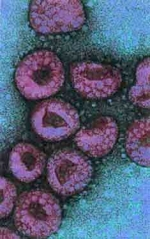
NO BOWL OF RASPBERRIES: THE H5N1 VIRUSThe disease-of-the-week thing is old. Since 9/11 we’ve seen (more like, heard about) West Nile virus, SARS, the original, dreaded H5N1 bird flu, untreatable TBX tuberculosis, MRSA, and swine flu. Someone even dusted midtown Manhattan with government-issue anthrax. So why should Gothamites care about some remix of a flopped disease that scared everyone silly in 2006 and then flew off to plague (mostly) Egyptians and Indonesians while the pigs plagued us?

Because this one’s a Category 5 hurricane, folks. Welcome to the Ninth Ward.

Novel H5N1 has everything the Great Pandemic Flu of 1918 had, and more. It’s transmitting more easily every day and it looks to be able to kill a greater percentage of people more horribly than any influenza ever recorded. Far more than anyone predicted swine flu would kill.

The remarkable strain that surfaced in the U.S. and Mexico in 2009 with genes from birds, pigs, and humans spread more fear than fatality before we gained immunity to it. Nowhere was the toll as high as the media said it might be—when it wasn’t mocking its own warnings—but flu mortality is tough to quantify. It's clear that a lot of young people who would never have succumbed to seasonal flu were killed, but influenza always invites other conditions to take the final credit.

It’s easy to forget how scary swine flu was before it turned into another noisy dud. People in poorer countries suffered much more than we did, though I knew someone who died from it. I miss her. Only fools dismiss A/H1N1 swine flu as microbial Y2K.

Still, who wants another one? How can we even contemplate such a thing—let alone something far worse? Isn’t there supposed to be a long gap between pandemics?

Sometimes.

The world experienced huge flu outbreaks in 1946-47, when the vaccine utterly failed, and 1951, when Liverpool’s weekly death toll was greater than during the 1918 pandemic. Then came the 1957 H2N3 Asian Flu pandemic. That’s a lot of virulence in what, 11 years?

Back when swine flu was exploring the earth in its first wave, flu blogger Scott McPherson speculated that H1N1 might be conducting its “farewell tour,” just the way those epidemics in 1946-7 and 1951 turned out to herald that strain’s collapse in 1957. He was right. This year, the H1N1 that’s been around in one form or another since it revived in 1977 has been melting away.

Swine Flu's Secret Punch

The problem is that swine flu left a memento. True to its nickname, it managed to get into Indonesia’s pig population. There it encountered H5N1, the incredibly nasty bird flu that loves to get into mammals but had been having a hard time getting humans to give it to each other.

Nature cares little for irony, so it's mere coincidence that a Muslim country hosted the porcine union that inspired the historic viral bonding. H1N1 gave up some vital genetic snippets—presumably through a process known as reassortment—and soon H5N1 was killing a lot more Indonesians. Then Vietnamese. While I don’t trust the numbers from China, the government is obviously trying to suppress a roaring panic in Guangdong. I’m still waiting for the new H5N1 to reach Egypt, where I fear it will land like sparks in a parched field. (Egypt has been dealing with H5N1 cases since 2006.)

In a month, this mutated avian flu has struck four continents, killed at least 500 people, and even shown signs of picking up immunity to Tamiflu—the primary antiviral medicine in the world’s flu arsenal. While H5N1 swiftly learns how to infect us, we’re learning that humanity drew the wrong lessons from swine flu.

Most people are stlll guzzling assurances that Novel A/H5N1 is not a threat. Even tonight, opinion makers argue that avian flu has lost its bite. Why, it used to kill two-thirds of its victims! Now it’s down to a few percent—mostly fools with underlying health conditions, or foreigners who don’t eat as well as we do. No worries. Let’s keep our financial markets on an even keel. Let the tourist industry weather the latest threat.

We’ve seen worse, right? There was no panic in the spring of ’09, when people traveling out of New York brought swine flu to scores of countries. I recall a party in Williamsburg at which I complimented the hostess on the creamy chocolate strawberry cake I was devouring. "I could hardly finish it because I'm just getting over the flu," she murmured. I gazed at the moist chunks of tasty textured fluff and opted not to stash her confection behind the punch bowl. So many yummy virions!

DIY, ASAP

This is no time to be smug. Sure, I sell personal protection gear on this site—and I can’t prove it makes much difference for non-health workers to wear professional-grade masks, goggles, and gloves—but I got into this line because I was scared. I wear the gear myself. I want to do something to fight this disease. I’ve known for years that a killer influenza pandemic is inevitable.

How could I be so sure? I wasn't alone. Pandemics have been raging since people gathered in cities that traded with one another. One of the remarkable features of a true pandemic is that the previously dominant flu strains (for us, it’s been H3N2 and H1N1 since a likely lab accident in 1977 revived H1N1) tend to give up the ghost when a new pandemic strain comes along. Suddenly—around the world—people are far more likely to catch the new strain. No one knows why, but the old subtypes bow out gracefully.

In April 2009, when swine flu broke out along the Mexican border, the seasonal flu strains were already subsiding. Americans looked forward to summer. But when Novel H1N1 turned up, the seasonal strains responded by reactivating intensely for a couple of weeks, as if to vanquish an intruder.

That told me swine flu was missing something—a kind of legitimacy—and that the other strains knew this. (If this sounds paranoid, be warned that I consider influenza a natural system that humans have yet to fathom, kind of like a social network teeming with invisible murderers.)

Guess what? This time, the seasonal strains have vanished—relatively early in our season. H5N1 is gathering force like a prince assuming the throne.

It’s time to admit that another pandemic has begun, whether or not we like the timing. (In detail, it's never what we expect: H1N1 swine flu defied conventional logic in many respects.)

Don’t look to the world’s various political and economic systems for help. Swine flu made experts and authorities look ridiculous after they’d spent years preparing for the bird flu that now threatens. Have you watched the World Health Organization wrestle all over again with the questions of whether and when to declare a top-level pandemic flu threat? The agency dithered for weeks over its conditions for swine flu—why not do it again? The countries whose voices count never want a pandemic. Who does?

By the time the threat is formally recognized, H5N1 will be upon us.

It’s already here, where I live. Coming soon to your ‘hood. Get ready.

And oh yeah, welcome to my blog. I haven’t ever done this before, so please be kind.

I invite you to visit the excellent flu bloggers and news sources I rely on. Most have been reporting and analyzing viral developments for many years. We’re fortunate to be entering this crisis with such seasoned commentators.

See you tomorrow.

Monday
06Jul2009

Day 2: Cracks Appear in Our Medical Temples

With four people dead in New York and 50 more in intensive care, we’re suddenly awash in flu news. To me the biggest story is in Vancouver, where a family of tourists from Shanghai who were fit when they landed 10 days ago is now in the ICU.

Not that some aren’t still fiddling. While the WHO meets again to debate red vs. orange alerts, veteran flu debunkers are all over our TV screens, still peddling cynicism. They ardently cite New York’s past scares and promise that this month’s menace will pass, too. Sometimes I wonder if these types would have sneered at the 1918 pandemic, too: Hey, what’s all the fuss? I feel fine. The Black Death was so much worse and we’re all here, right…?

Like the Wall Streeters who kept insisting dotcoms and real estate would pay off forever, the flu skeptics have been right for years. Swine flu was a picnic for them, a pleasure to behold. But as with the bubbles that blew our economy to bits, a really nasty pandemic is inevitable. The downside will be far worse than any stock market crash. (Financial Armageddon will be the least of it.)

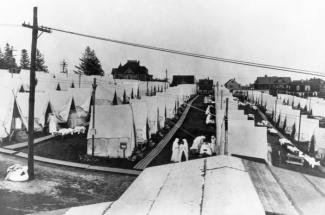
THE GREAT PANDEMIC, 1918: AMERICANS USED TO BE SO NEAT AND CIVILIZEDThe fistfights I see on TV outside the nearest hospital hint at what’s coming. The riot squad is unprepared. Oh, they’ve got plenty of weapons. But their paper masks are a joke. Helmets and clubs and tasers won’t protect cops from flu as they face off against flushed and furious New Yorkers wrong-headedly desperate to get inside a building that’s bursting with virions.

The hospitals are full of frightened, sneezing people. It is reported that some doctors, nurses, and technicians are already missing in action. They know what we face. Many were given paper surgical masks that are arguably next to useless at blocking the tiny aerosol particles that float around after people cough or sneeze.

The pros know that our hospitals—culled by recession and redesigned by HMOs to shed any excess capacity they used to carry—can’t cope with virulent influenza. Those who slashed medical personnel and resources made no provision for surges in demand. A systems failure anywhere can mean catastrophic collapse for all.

Nothing could lure me to a clinic tonight. Survivors will someday look back on today’s emergency rooms with revulsionas we now think of the notion that surgeons would slice into us with unclean hands and tools. American hygiene still isn’t what we prefer to imagine.

It’s safer to stay home with people and creatures we love, and who care about us enough to hydrate us in a pinch. In this regard, I’m a lucky man.

Newbies to H5N1 can pass the early self-quarantine days reading copies of Dr. Grattan Woodson’s excellent The Bird Flu Preparedness Planner and The Bird Flu Manual, or download for free his Good Home Treatment Of Influenza. (Yes, he’ll tell you all about hydration.) A more intensive home-care guide can also be downloaded free:Pandemic Flu Home Care: A Detailed Guide for Caring for the Ill at Home.

My home is crammed to the ceilings with boxes of the best respirators, masks, gloves, goggles, and disinfectant I could stockpile. I hope to save a lot of lives. Anyone who doesn’t catch the flu is a person who won’t spread it, so I take pleasure in helping people who will never even hear of my wares.

But surviving this thing will take more than protective gear. It will take wit and heart and luck. It will take the do-it-yourself spirit that animated the American settlers and New York punk rockers of yore. DIY can save us. It kinda has to.

As long as the Internet holds up, we’re linked. There will be times the digital thread fails us—when electricity is cut, servers can’t handle increased demand, or workers are too sick to keep the ISPs afloat. I won’t be surprised if criminal botnets try to do more than sell phony flu cures and counterfeit Tamiflu. People still robbed banks in 1918; masks must have made it easier.

For now, we’re joined in our isolation. We can safely trade insights to help each other survive. Write to my new blog email and I’ll post tips I like. (Note that this is a separate web address from the one regarding sales.)

My digital bean counter says I’ve already snared some readers. I presume they came to buy and stayed for the bonus verbology (with a hint of virology).

Next, I'll have more to say about how we can defend ourselves. It's not too late! Yet.

Sunday
12Jul2009

Day 3: A Libertarian With Hopes, Fears & Regrets

I’d like to apologize for yesterday’s post. My friendly unofficial editor says it looks boastful, the words of a wise guy who saw it all coming.

I’m not here to lecture anyone. I don’t need a blog to sell my products.

I hope I’ve made it clear that I’m more frightened than most of you. I’ve built a lifetime hoard of masks and gloves and goggles and disinfectant, and I’ve been hiding at home for more than a week. My roommate and I withdrew from the world after H5N1 killed those vegans in Stockholm. The authorities couldn’t blame chickens for their condition.

I’m also sorry that some of you thought I was encouraging medical personnel to stay home. I recognize that these times call for heroic acts, even if our first responders haven’t been properly equipped.

But I respectfully—violently might be a better adverb—oppose the idea that they should be arrested and prosecuted for dereliction of duty. They are civilians, not soldiers.

A lot of states have been passing emergency legislation to yank licenses from medical professionals who fail to show up for work. If the government is going to approach this deadly emergency by punishing the living, we’re worse off than I feared we’d be.

As for my politics, I can assure you I’m not particularly liberal. I am libertarian with a small l. I trust few politicians, no parties. No institutions. I would have voted for Clinton once, but I was too young. In my adult years, I haven’t seen leaders do much I consider praiseworthy. I’ve watched the presidency amass powers that no one who signed the Declaration of Independence would ever have endorsed.

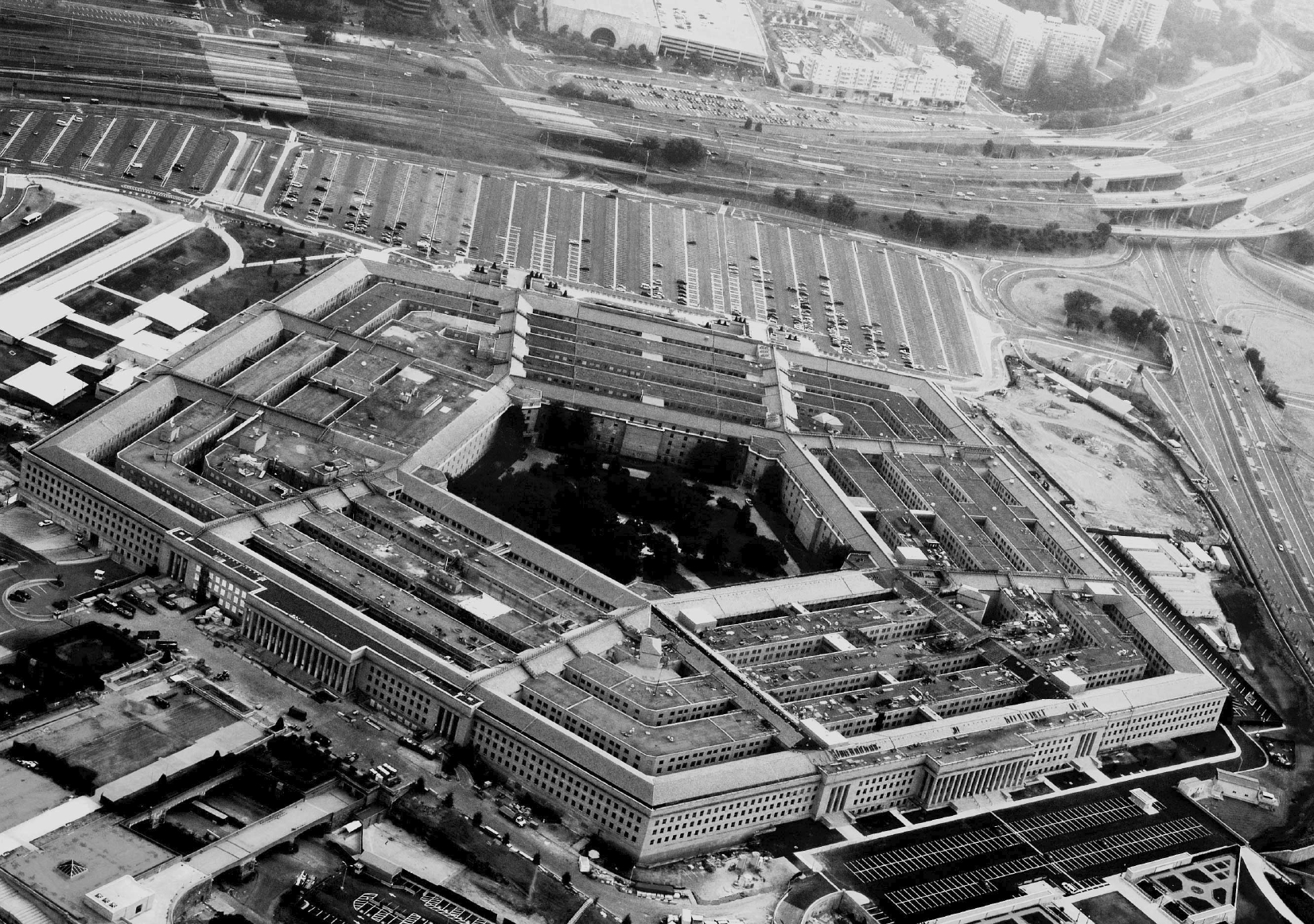
SINCE KATRINA, THE PENTAGON CARES MUCH MOREIt’s nice to think that persevering civil servants in Washington will ensure we have enough food, water, electricity, and heat. But as this report from the American Civil Liberties Union warns, they’re far better geared to lock us all up. Post-9/11 doctrine gives the U.S. military and the Department of Homeland Security the authority to force Americans to be medicated, quarantined, and vaccinated if the president declares it necessary. Today's Pentagon intensively tracks flu around the world.

Right now the libertarian I know best just wants the government to function politely and effectively.

Be warned that I do not intend to comment on electoral matters. I do not support or expect much from any organization, not even the one called Libertarian. I may discuss matters that sound political, but this is a nonpartisan blog!


I intend to survive this nightmare in the heart of America’s greatest city. This will be a record of what I perceive. So far, I can’t say I’ve witnessed much.

I can report that my neighbors across the street laid an egg with their annual April Fools bash, though it’s been a gorgeous night. Normally the NYPD would have crashed the party by now. But guests are scarce—just empty thumping pop and ripples of laughter. New Yorkers are lying low.

I’m overwhelmed by demand for personal protection items so I have work to do. I’ll return tomorrow with some useful information.

Stay well.

Tuesday
14Jul2009

Day 4: Pandemic Prescription: Generational Conflict

I hate to sound like a debunker, but so far most of the cases arising here in New York City are false alarms.

This being hay fever season, the prospect that a subway sneeze could waste everyone in the car has propelled thousands to the emergency room. The pictures of corridors and sidewalk tents crammed with anxious people, paper masks askew, are reminiscent of 1918. Sick people sure dressed better then.

At best, the surgical masks being handed out can only help protect the world from whatever illness the wearer might have. They’re less useful at protecting you from germs others might hack up. In Japan, sick people wear the paper masks.

Most viruses are tiny enough even to get around N95s, a better-fitting, higher-grade paper mask best suited to stopping clunky bacteria. Wear them carefully. They offer some protection until your breath moistens the paper, causing it to collect microbes.

Nevertheless, it’s too early to see such crowded hospitals. H5N1 is still trying to figure out how to nail us. It’s not there yet.

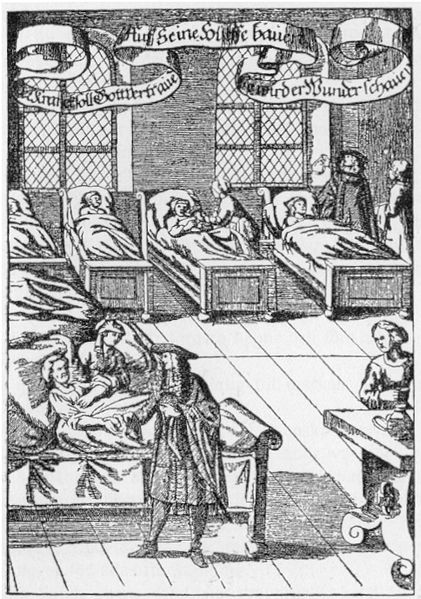
ARE THE BOOMERS GOING TO OUTLIVE US, TOO?Most of these people are fine. They should rinse their sinuses and take antihistamines (even better, chew and drink fresh ginger). Those who are genuinely ill will receive less care because hysterical allergy cases are disrupting the system. That will help H5N1 circulate wider and faster.

Public toilets will, too: Flushing infected waste aerosolizes the microbes, turning them into a fine mist. Short people and children in particular ought to close the lids before they unleash clouds of nasty virions. (Don’t even think about airplane lavatories—those cramped and smelly plastic enclosures, brimming with germs so violently and constantly stirred….)

Stores are emptying. Pharmacies are arming their guards. People are bashing pigeons in the streets (not the best idea if the birds are sick—peasants in Southeast Asia long ago learned what H5N1 can do to people who slaughter infected chickens and ducks).

Before we succumb to pointless anxiety—as opposed to the kind that might make us prepare while there’s still time—I’d like to point out that each generation faces a different level of risk.

Influenza is tricky. It works much of its harm indirectly. Even though seasonal flu concentrates on the very old, half of the elderly wind up succumbing to opportunistic infections, mainly pneumonia. The flu virus weakens them and pneumonia bacteria swoop in for the kill.

Though seasonal flu can harm the very young, whose immune systems aren’t yet up to speed, it’s easily repelled by teenagers and young adults. Their immune systems reject opportunistic infections, too.

No Shelter From the Cytokine Storm

But pandemic flu brutalizes youth. It provokes an immune response that is 10 times as intense, a blistering reaction that scorches the victim’s lungs beyond repair, flooding them with white gunk. Scientists disagree as to whether this is caused by the much-discussed cytokine storm, by which our bodies seem to ordain ‘programmed cell death.’

Some think our genetic defenses are so inflamed by failure to kill the virus that we destroy our vital organs one by one—first the lungs, then the kidneys, liver, and so on. Others cite experiments with steroids aimed at overcoming the immune response to see if this heightened the odds for survival. The flu ripped most test subjects to pieces anyway. They could have saved the time and trouble by looking at how badly pandemic flu affects pregnant women, whose immune systems are repressed.

The elderly are not a prime target of pandemic flu. They’ve already survived so much that their immune systems are tired, too relaxed to kill them. In 1918, people over 65 accounted for only 1% of excess deaths. The rate at which folks over 75 were killed by influenza and pneumonia fell that year.

Some scientists think that’s because they had already been exposed to 1918’s H1N1 strain. An important paper came out in 2005, contending that H1N1 crossed directly from birds to people in or just before 1918 (and then we gave it to our pork chops, who gave it back to us as swine flu). Just four years later another group of top experts published a paper establishing that pandemic flu circulates quietly for years before bursting into public consciousness. (Debunkers lost a valued weaponthe argument that what hasn't hurt us won't do sobut they didn't seem to notice.)

It's still baffling how the older generation could have been exposed to pandemic 1918 H1N1 many years earlier. I told you influenza is mysterious, and the best minds agree: "The emergence pathway of pandemic flu strains remains unknown," said the second paper.

As for our H5N1, a study in England has claimed that people born before 1969 seem to bear some immunity to a virus that was never known to affect people until 1997. In 2008, a panel of WHO experts reported in The New England Journal of Medicine that “approximately 15 to 20% of older adults have some baseline neutralizing antibodies to H5N1 virus….”

While I like the Boomers (who could fail to cherish their childlike egocentricities?), it’s a little creepy to think that nature may contrive to help them outlast me.

For the few who might wonder how these lucky geezers acquired immunity to H5N1, the authors quietly added: “The mechanisms leading to these antibodies are uncertain.” The deeper I dig, the more I see how little the big guys know about influenza. I’ll continue to excavate—the alternative is too grave to contemplate or accept.

What is clear is that 90% of H5N1’s victims have been under 40; half were under 18, with most of them 10 or older. Younger kids tend to survive nearly as well as people from 50 to 70, probably because their immune systems are too immature to put up a vigorous, suicidal defense. Those aged 10 to 40 have the most to fear.

The debate continues over who gets whatever vaccines or antiviral drugs become available. Nine countries manufacture more than 90% of the world’s vaccines: France, Britain, the U.S., Canada, Australia, the Netherlands, Germany, Italy, and Japan. Even with India, Brazil, and China making great leaps in productive capacity, no nation will be able to make enough vaccine for its own citizens, let alone other countries’.

As happened with swine flu, the vaccine seed stocks are rumored to be growing badly and it begins to look as if many fortunate citizens of the best-endowed nations won’t feel that needle until at least January. That effectively leaves us in the spring of 1918, when scientists who had never seen a virus thought bacteria caused flu. Most fatalities that year came by Christmas. When you read an article that assures a vaccine impends, look for the fine print. Remember how much the government promised in 2009. If you can’t find cautionary language, toss it.

For now there are limited stocks of antiviral medicines and there’s no vaccine I consider useful. I won’t pollute my body with the prepandemic vaccines they’re giving out. These are based on H5N1 strains captured long before they mutated into the current killer flu. I may be wrong, but I don’t expect them to help much and I distrust some of the ingredients (though these are likely to pop up in the pandemic vaccine we long for, too).

Quack Alert: Don’t Inject Peroxide or Buy Weird Herbs

We must guard against medical campaigns to deploy useless assets. As John Barry points out in The Great Influenza, In 1918, desperate doctors shot patients up with typhoid vaccine, quinine, even hydrogen peroxide. If half the subjects survived, any abomination was hailed as a breakthrough.

Of the useful stuff—unexpired antivirals and a vaccine based on the actual killer strain— society is again considering whether these should go to the old or to the young. With swine flu, they wisely targeted (pregnant) women & children first, along with health care and EMS workers who would be directly exposed to patients or infectious substances. (As with the SS Titanic’s meager lifeboats, it didn’t always work out that way, especially where the Pentagon, law enforcement, politicians, and celebrities were concerned.)

If 1918 is any guide, the elderly are indeed in peril, but not directly from H5N1. They stand to lose services that are already keeping them alive. The system won’t offer much support or medication for conditions like cancer, diabetes, or heart or lung disorders. A century ago there were numerous deaths from tuberculosis, whooping cough, and premature births. Influenza may even trigger heart attacks.

Scientists have recently been adding obesity to the list of known flu risk factors that include asthma, pregnancy, and diabetes. That’s progress for you: In Flu: A Social History of Influenza, Tom Quinn quotes a doctor’s observation during the influenza pandemic of 1831 that “stout young men” and pregnant women were more likely to contract pneumonia.

For years, skeptics have proclaimed that our advanced civilization—our antiseptic society—could easily withstand an avian flu pandemic. I say sophistication cuts both ways: We didn’t use kidney dialysis systems in 1918. There weren’t millions living with cancer. This makes us more vulnerable to disruption, not less.

How will elderly Americans deal with traditionally fatal, chronic illnesses? Who will tend them? With what? In keeping with our just-in-time inventory system, the only stockpiles of medicine and ventilators are maintained by the Feds. I don’t know where the stuff is located, but it can‘t possibly suffice. Heck, I hear fuel is running out. Coffins and body bags will be scarce. The only products that seem plentiful are bogus flu remedies featured in spam emails, phone calls, and texts.

The elderly feel vulnerable and they vote.

The young are vulnerable to this flu and they do not.

No matter. Our views won’t count for much. I’ll bet that most of the antivirals and/or any early vaccine goes to politicians, generals, doctors, soldiers, cops, utility and communications workers, and businessmen. Some nurses might get lucky. The American Civil Liberties Union long ago pointed out that judges didn’t make the preference lists. Don’t expect anyone important to hear your complaints if the law comes crashing in.

It’s both too early and too late, of course, to give vaccine to the folks whose continued health should matter very much to us—the overseas workers who make more than 85% of the pharmaceutical products we use. Just-in-time could quickly turn into way-too-late for masks, gloves, goggles, needles, syringes, IV bags, ventilators, and antibiotics.

LOVE,THE DEVIL, AND THE DEATH OF KURT COBAIN (© Frank Zirbel)

A final note: I’m receiving a lot of email for a blog that’s only two days old. Some ask why my site doesn’t let readers post responses. “What are you afraid of?” asks one. “Think we’ll finally unmask you?”

Such melodrama.

For the sake of innocent readers I’ve acquired, I’ll explain that I don’t want to have to monitor the site for abuse. Nor will I host debates about what politician would make a worse president, or which movie star or pop singer is doing more to fight bird flu ("I feel stupid and contagious/here we are now/entertain us").

In fact, I already recognize the voices of old antagonists from the bird flu boards. Some accuse me of being someone else—an old web ploy that’s never fooled me. I’ll quietly and happily ignore them.

But please send me an email if you want talk back. I welcome it. I'll respond to interesting points. Just don't expect me to publish them verbatim.